The Pulse is a series covering events, insights, and trends within Big Tech and startups. Notice an interesting event or trend? Hit reply and share it with me.
Today, we cover:
Meta follow-up. A follow-up on Tuesday’s deepdive into Meta’s ongoing demolition of its own engineering org. Non-engineering teams lost more than 10% of their staff, while Integrity teams were already stretched before the cuts and reallocation.
Big implications of the US banning Anthropic’s new model, Fable. The US government wants only US citizens to be able to use Fable. That could make China more influential as other countries and non-US companies look to capable open models – most of which come from China.
SpaceX, Cursor, Continue. Elon Musk became a trillionaire with SpaceX’s IPO, while SpaceX acquired Cursor, and Cursor acquired Continue. SpaceX looks like it wants to go head-on against Anthropic and OpenAI.
Industry Pulse. Gemini lead quits for OpenAI, Epic Games’ new open source version control system, Microsoft considers dropping OpenAI for DeepSeek, research confirms LLMs amplify existing expertise, and more.
1. Meta follow-up
Tuesday’s article about Meta destroying its engineering culture made quite the splash in terms of comments and debate online. From inside Meta, there was positive feedback on the accuracy of the deepdive into the situation, and there were also a few helpful clarifications and new information which I’m happy to publish here:
Listen and watch now on YouTube, Spotify, and Apple. See the episode transcript at the top of this page, and timestamps for the episode at the bottom.
Brought to You by
• Antithesis – if you're using agents to code, the problem isn't writing the code but making sure it didn't break anything. Antithesis goes beyond code review and runs your whole system in faster than real-time and identifies hard to find bugs before your users hit them in production. Antithesis enables teams like Jane Street, Fly.io, and the etcd community to use agents safely and ship better code, faster. Learn more
• WorkOS – make your app and agents Enterprise Ready, with SSO, SCIM, RBAC, and more. Get started.
• turbopuffer – a vector and full-text search engine built on object storage. It’s fast, cheap, and extremely scalable. The teams building the smartest AI products out there — Cursor, Notion, Cognition, Anthropic — they all run on turbopuffer.
In this episode
Robert Erez is a principal engineer at Octopus Deploy, and a longtime expert in CI/CD, deployment systems, and software delivery. Rob and I were also once colleagues on the Skype web team, working on large-scale deployments and release processes.
In this episode of ThePragmatic Engineer, I sit down with Rob to discuss how teams deploy software safely and efficiently at scale. We cover Kubernetes, GitOps, platform engineering, progressive delivery, feature flags, cloud development environments, and the growing role of AI in CI/CD workflows. We also get into the tradeoffs in different deployment approaches, why self-hosted software still matters for some organizations, and the recent evolution of software delivery practices.
Key observations on deployments and CI/CD from the conversation with Rob
Here are 10 interesting takeaways from our chat:
1. Roll forward, never backwards. When a system has state – which typically means it uses databases – then doing a rollback can leave the code talking to a schema that’s no longer in sync. Rob’s advice is to not treat a failure in v2 as a trip back to v1, but rather as a push to v3 with the fix in it.
2. GitOps isn’t actually about Git. None of the four pillars of GitOps – 1) declarative, 2) versioned and immutable, 3) pulled, not pushed, 4) continuously reconciled – require Git, although Git can work under these constraints. Yet, the term ‘GitOps’ has made the industry dogmatic about cramming everything into a repo – even things like secrets that absolutely shouldn’t be there!
3. Continuous deployment can be overkill; continuous delivery is more practical. Shipping every single change to prod (continuous deployment) is not as necessary as many people think, Rob says, and there’s often more value in continuous delivery, where changes flow through testing and the deployment process itself is validated. With continuous delivery, you can decide whether to push to production automatically, or click a button once a week.
4. Feature toggles are a better safety net than rollbacks. When something breaks in production, reaching for a toggle to switch a feature off enables you to “stop the bleeding” and then calmly diagnose an issue. Rolling back a feature flag is less nerve-jangling than scrambling to force a redeployment in the middle of the night!
5. One problem with feature flags is that they’re addictive. On the other hand, the ease with which feature flags are added can create a hygiene crisis if they’re continuously added, but not removed. Treat feature-toggle cleanups like a form of gardening and “weed” rolled-out toggles from the codebase.
6. A Git repo can be a bottleneck at scale. Rob mentions that some companies run thousands of independent Kubernetes clusters that pull state from a Git repository. But such clusters can get throttled by the repo, forcing them into workarounds. Pull-based GitOps doesn’t scale infinitely for free.
7. A sizable number of major institutions remain on-prem – and this won’t change. Banks, other financial bodies, and governments, demand full control over their hardware, upgrades, and downtime. That’s why Rob expects this segment won’t move to cloud-based SaaS.
8. Platform teams work at larger companies. These teams earn their keep in big organizations with multiple teams and projects because they offer ways of bringing sanity and focus.
9. There’s a trend of ephemeral environments replacing test/staging environments. Companies used to have a few testers fighting over a handful of static test environments, but today, it’s trivial to spin up a full environment, per-feature branch, pre-merge. This is an “ephemeral” environment for evaluating that things work, which is then torn down once something is merged. It helps speed up the feedback process.
10. AI shifts the CI/CD calculus from speed to risk. Today, shaving ten minutes off the CI build-time matters because a long-running build blocks human devs. But this time saving will be insignificant when an AI agent writes most of the code and “babysits” a slow pipeline without context switching. Then, the new priority will be to reduce the risk of an AI agent shipping a bug to production, so it will make much more sense to run extra, more thorough, tests – and also even slower ones.
The Pragmatic Engineer deepdives relevant for this episode
Hi – this is Gergely with a free issue of the Pragmatic Engineer Newsletter. In every issue, I cover challenges at Big Tech and startups through the lens of senior engineers and engineering leaders. Subscribe to get deepdives like this in your inbox, weekly:
For two decades, Meta had a unique, high-performance engineering org; right up until around April of this year. For the first 20 years of the company’s existence, it had a “move-fast-and-break-things” culture, and in the early 2020s this shifted to a “move-fast-with-stable-infra” one. Engineers I know at the company were empowered to do good work, focus on impact, and to balance business interests with solid engineering.
But in the past few weeks, all that has changed, as if the leadership has been following detailed blueprints on how to demolish a proven, successful engineering culture in the most ruthlessly efficient way possible.
For the past few weeks, I’ve been sharing how bad things are inside the social media company for engineers in one of Silicon Valley’s most prestigious workplaces. In this article, we walk through what’s happened, and ask what’s going through the minds of leadership who are reducing software engineering there from the profit center that it was between 2004 until very recently, to the disdained cost center that it has become in just a few weeks.
We cover:
Meta’s pre-AI engineering culture
Investing in AI and pressing engineers to always use it
Core engineering folks feel treated like trash
Most embarrassing-ever outage
Internal mess
Self-inflicted wounds
Is “AI psychosis” just a Meta issue?
1. Meta’s pre-AI engineering culture
I’d split Meta’s engineering culture into two eras: “move fast and break things”, and then “move fast with stable infra.”
“Move fast and break things”
In the 2010s, Facebook’s unconventional engineering culture had grown somewhat legendary in the tech industry, as the company went against conventional best practices and succeeded massively.
In 2012, when Facebook hit the billion-users landmark, the company produced a small physical book about its culture which was placed on employees’ desks. Presented with retro propaganda design, it was dubbed the “little red book”, co-opting the name of a famous volume of the thoughts of Chairman Mao, (1964).
At around 70 pages long, Facebook’s version codified its engineering culture: speed, fearlessness, taking ownership, and thinking outside of the box.
Back then, mantras in Facebook’s little red book were also in print across campus, and included:
Move Fast and Break Things
Done is Better Than Perfect
Fail Harder
What Would You Do If You Weren’t Afraid?
Every Day Feels Like a Week
The Wright Brothers Did Not Have Pilot Licenses
The Foolish Wait
Fortune Favors the Bold
There was genuine focus on building good products. Also from the book:
More from Facebook’s Little Red Book
“Move fast with stable infra” culture
In 2022, I did what is one of the longest deepdives we’ve published on the topic of Meta’s engineering culture. By then, things had evolved, and much of any former recklessness was gone, replaced by the principle of moving fast, but with stable infra. Here’s how I described Meta’s engineering culture then:
“The culture is incredibly engineering-centric: much more than most of Big Tech. This might come from Mark Zuckerberg being an engineer himself, or because much of the innovation in the early days of Facebook came from engineers.
Focus on individual impact. Impact has been the bread and butter of the focus at Facebook. This is very true since the early days, and the focus on generating impact remains.
One detail in common with most Big Tech firms is that both the engineering culture and general culture focus so much on individual impact. This results in some people focusing on short-term, measurable wins and assuming that teamwork and split wins between groups might be less rewarded.
The lack of rigid processes. Facebook seems to have the least amount of processes or standardization across all of Big Tech. Don’t even try to compare it to Amazon’s engineering culture and the countless formal processes there. But even compared to companies like Google, Microsoft or Uber, Facebook’s processes are much looser. Most of this comes from the engineering-centric nature of the company and engineers disliking processes.
Surprisingly little emphasis on testing, documentation or code comments. You’ll find shockingly little automated testing and documentation at Facebook, compared to the rest of Big Tech. Inline code comments are also very rare.
A founder-engineer driven company. Facebook is one of the few Big Tech firms whose founder is an engineer, and still is the CEO. Netflix is the other one where founder and co-CEO Reed Hastings was also a software engineer before starting the company. Amazon was the other example of this until recently, but it’s not the case at Google or Apple. There are good examples of smaller companies like Cloudflare, but they’re all younger than Facebook.
Bootcamp. A unique onboarding process, unlike what any other Big Tech firms offer. We cover this more in the Bootcamp & onboarding section.”
Engineers whom I knew inside the company are capable, motivated, and product-minded, and their work was appreciated. CEO, Mark Zuckerberg, was influential: he personally coded the first version of Facebook, had stayed close to engineering, and valued software engineers very much. Engineers there felt they were working inside a profit center.
2. Investing in AI and pressing engineers to always use it
Meta has been the only company among the big five of Apple, Microsoft, Amazon, Google, and itself not to own a hardware platform or operating system. Apple has the iPhone, iPad and Macs, Google has Android, ChromeOS and Pixel phones, Microsoft has Windows, and Amazon has the Kindle.
Stepping back, it looks as though the Mark Zuckerberg of today has resolved not to miss a platform opportunity, after the company failed to build its own mobile OS or mobile phone during the 2010s.
This is one reason for investing so much in virtual reality (VR) with Oculus, and in augmented reality with the Meta Glasses. Facebook changed its name to Meta in 2021, back when it looked like VR – and the metaverse – could be massive. Billions was spent on ensuring Meta would be the market leader in this space. But once again, VR didn’t go mainstream; since the end of the pandemic, popular interest in the segment has died down considerably.
When it became clear that AI would become a mega-trend in 2022, Zuckerberg didn’t miss it: he assembled the internal FAIR group (Fundamental AI Research team) as well as a GenAI product organization and released a series of open-weight AI models:
Llama 1: released in Feb 2023, three months after ChatGPT, built by FAIR
Llama 2: in June 2023, built by the GenAI product organization (as well as all subsequent Llama models)
Llama 3: in April 2024. This model was Meta’s most competitive LLM of all, and gained momentum in adoption across the industry
In June that year, Meta acquired a 49% stake in Scale AI to reboot its AI efforts for a whopping $14.8B, and brought in Scale AI’s CEO, Alexandr Wang to take over Meta’s AI strategy. The acquisition of Chinese startup Manus AI for $2B is currently in question after China blocked the deal from being completed.
Based on the investment made into Scale AI and Wang, it’s pretty clear that Meta – and Zuckerberg – is determined to build a state-of-the-art LLM that can be competitive with the latest versions of Claude and ChatGPT. But Meta has to start pretty much from scratch, and it’s up to Alexandr Wang to deliver.
Scale AI brings in a very specific kind of expertise to Meta, as one of the best in the industry in:
Training data and labeling: Scale started, and is still best known, as a provider of high-quality labeled datasets for machine learning and AI training, including code, text, image, video, etc.
RLHF and fine-tuning: A RLHF (reinforcement learning from human feedback) flow which Scale runs, where people give feedback for foundation models, as a “human in the loop” data engine that many leading AI labs use to create better LLMs.
Wang seems to have a very broad reign to do what he has been an expert in: creating training data, doing data labeling and RLHF. This is being pulled off with the labor of Meta’s engineering workforce, and by surveilling it.
Problem #1: Tracking keystrokes and mouse clicks, with no option to opt out. In late April, Meta told engineers they were being enrolled into a system that tracks every keystroke and click, to produce training data for Meta’s new AI. There’s no way to opt out.
Needless to say, this is invasive and raises privacy questions: If you log into your personal bank account, does the tool track you? What about when you’re writing a personal email, or responding to a personal call? Meta held no consultation and there are no workarounds; just a top-down decision being pushed through.
This month, Reuters reported that people’s concerns there are finally being heard:
“Meta is dialing back elements of its plan to collect employee mouse movements, keystrokes and other actions for use as AI training data, it said in an internal memo on Tuesday, following weeks of angry pushback from staffers.
New controls will allow employees to pause the data collection for up to 30 minutes at a time and request exemptions from the initiative, according to the memo, authored by Stephane Kasriel, a vice president in Meta’s AI model-building Superintelligence Labs unit.”
From talking with current Meta engineers, I understand the logging system has not been rolled out in the UK due to data protection regulation.
Problem #2: 30-50% of engineers on core teams have been forcefully reassigned to data labeling and RLHF, upsetting folks even more.Also starting in late April, product engineering teams received a mandate from above, whereby 30-50% of engineers were to leave the team and join the ADO org (Agent Data Optimisation).
“Forceful” reassignment is very relevant here because of Meta’s traditional engineering culture. Between its founding in 2004 and until last year, Meta gave engineers autonomy to choose where they work and what they work on. This was structural to how the company worked:
Engineers were not hired for a specific team (save for at the Staff+, levels, in some cases). They were hired to the company
During a 6-week bootcamp, new hires got familiar with Meta’s engineering culture and chose a team
Team matching meant talking with multiple teams who had headcount, doing small work with them, and finding a match
Internal transfers were easy, and often initiated by engineers
Team selection via bootcamp started to die down in around 2024, but any Meta engineer with at least two years’ tenure knows that previously they chose what to work on, and of course, could pick the most impactful thing to work on. And then, out of the blue, they’re assigned to a division where the impact is not clear, the work is menial, and doing it too long will surely hurt their career prospects.
“Data labeling” is more involved work, even though a bit repetitive. There are labeling tasks, where you create a website, then look at it and decide if it looks good or not, and give this feedback: this is the “typical” data labeling. But this is the less frequent type of work. But then there are more involved AI training tasks, which looks like this:
Come up with a task that the AI should do
Then write the tests that confirm the result
Package all of this up into a Docker container, using Harbor framework
Then read the code that the AI writes - often doing this based on feedback from several models, and give it feedback
This work is not easy to do — and you can see why you need good software engineers to do it! — but it gets repetitive really quickly. Most engineers who I talked to said that they found it hard to do this work motivated day-in, day-out. Then again, I did talk with an engineer inside the org who said that by varying the technologies they use, and challenging themselves, they found this work motivating and interesting! This engineer expects there to be more software engineering work coming up, after the phase of training passes. There’s a lesson here: when life gives you lemons, you can either complain about it, or you can make lemonade, like this dev has done so.
This training work is secretive across the AI industry, and vendors are offering $100+ per hour for devs to do this type of work. There are rumors across the industry that OpenAI and Anthropic spends more on these training environments (to make the models great at coding) than the model training run itself!
Infrastructure and security teams were hit especially hard by reassignments. I talked with several engineers in infra orgs, who had 30-50% of their teams drafted into the ADO org. And in some cases, it was the best engineers who left.
One engineer told me that the whole situation feels like the movie, The Hunger Games, when tributes are randomly selected and then removed from their environment, to something completely different. Except, at Meta, many more folks are being affected, with between three and five from a 10-person team going from building products used by hundreds of millions, to giving human feedback on AI-generated GitHub repos, over and over. So, a wider impact than in the Hunger Games, but with less drastic consequences.
Around 6,500 people are in the ADO org, more than at OpenAI and Anthropic. Roughly four to five thousand of these are software engineers. Meta has around 25,000 engineers, meaning that one in every 5-6 software engineers may now find themselves doing data labeling full time.
As you can imagine, people are actively open to new positions, and nobody is updating their job title on LinkedIn and elsewhere to “data labeling at Meta.”
I’ve spoken with people in this role and they don’t like doing it, and feel upset about the top-down decision making. The silver lining is that they still have a job, have retained their salary, and were not part of layoffs. They still have time to leave Meta for something that pays comparably and is not a data labeling job.
3. Core engineering folks feel treated like trash
Problem #3: a month-long waiting game, stoking fear across the company. On 20 April, Reuters reported that Meta planned to lay off 10% of staff in a month’s time, and Meta confirmed the news, meaning there was a period of four weeks when everyone knew that they could be unemployed very soon.
Forced reassignments to data labeling started to happen. As I covered at the time:
“Understandably, there are mixed feelings about this redeployment [to data labeling], with layoffs coming soon. On Wednesday, 20 May, Meta will announce layoffs. Perhaps those moved to do data labeling could actually be “safer” than colleagues on product teams. Of course, this is speculation, but it would be cruel if Meta cut devs reassigned to data labeling.”
Problem #4: Performance review is hyper-aggressive at Meta, so devs optimize all metrics. The internal performance review process, PSC (Performance Summary Cycle), is very stringent, compared to Google and Apple, I’ve learned. Managers inside Meta “fight” over the pay packets of their employees, which involves “knocking down” the packet of engineers on other teams, so their direct reports are ranked higher. It’s common to weaponize metrics in this process – be that business impact, the number of code reviews, number of lines of code written, pre-AI (see our Coding Machine archetype podcast on this.)
Quotas are handed down to managers for the splits of the workforce to be put in each ‘bucket’, and the internal politics gets heated as managers try to get their reports into higher buckets.
After a few years, engineers at Meta learn that the best way to not get a bad PSC rating is to have all metrics – impact, code committed, and other numbers – higher than their peers’ are. Learn more about the internal politics of performance calibrations.
Problem #5: tokens are measured as part of perf, so devs aggressively optimize for it. When layoffs were confirmed, engineers also learned that managers shall inspect token count during perf reviews. This raised worries that those with low token counts might be marked as underperformers and dismissed.
So, what is the natural reaction to this as an engineer at Meta? They started using AI tools for the sake of generating more tokens. This happened while Meta had an internal token leaderboard, encouraging tokenmaxxing. As I wrote on 16 April:
“As per The Information, Meta employees used a total of 60.2 trillion AI tokens (!!) in 30 days. If this was charged at Anthropic’s API prices, it would cost $900M. Of course, Meta is likely purchasing tokens at a discount, but that could still come in at $100M+ – in large part from senseless “tokenmaxxing”.”
The biggest problem: people stop caring about real work and focus on performative work. Let’s check the four ingredients that Meta’s leadership has decided to introduce to their workplace:
Tracking the keyboards and mouse clicks of all engineers, where legally possible
Reassign a good chunk of engineers to fulltime data labeling
Let staff know that 10% of them will be laid off
Have a culture where devs optimize for any and all metrics measured during PSC
Measure token usage as part of PSC
Shake this mix up well, and what do you get? Two things:
Everyone overuses AI to boost their personal stats. An engineering workforce that pretends to work with as much AI, and as little human input, as possible. It’s a strange incentive where an outage caused by a failure to review code properly is not grounds for dismissal, but writing code by hand – instead of having an AI agent write it – could cost you your job
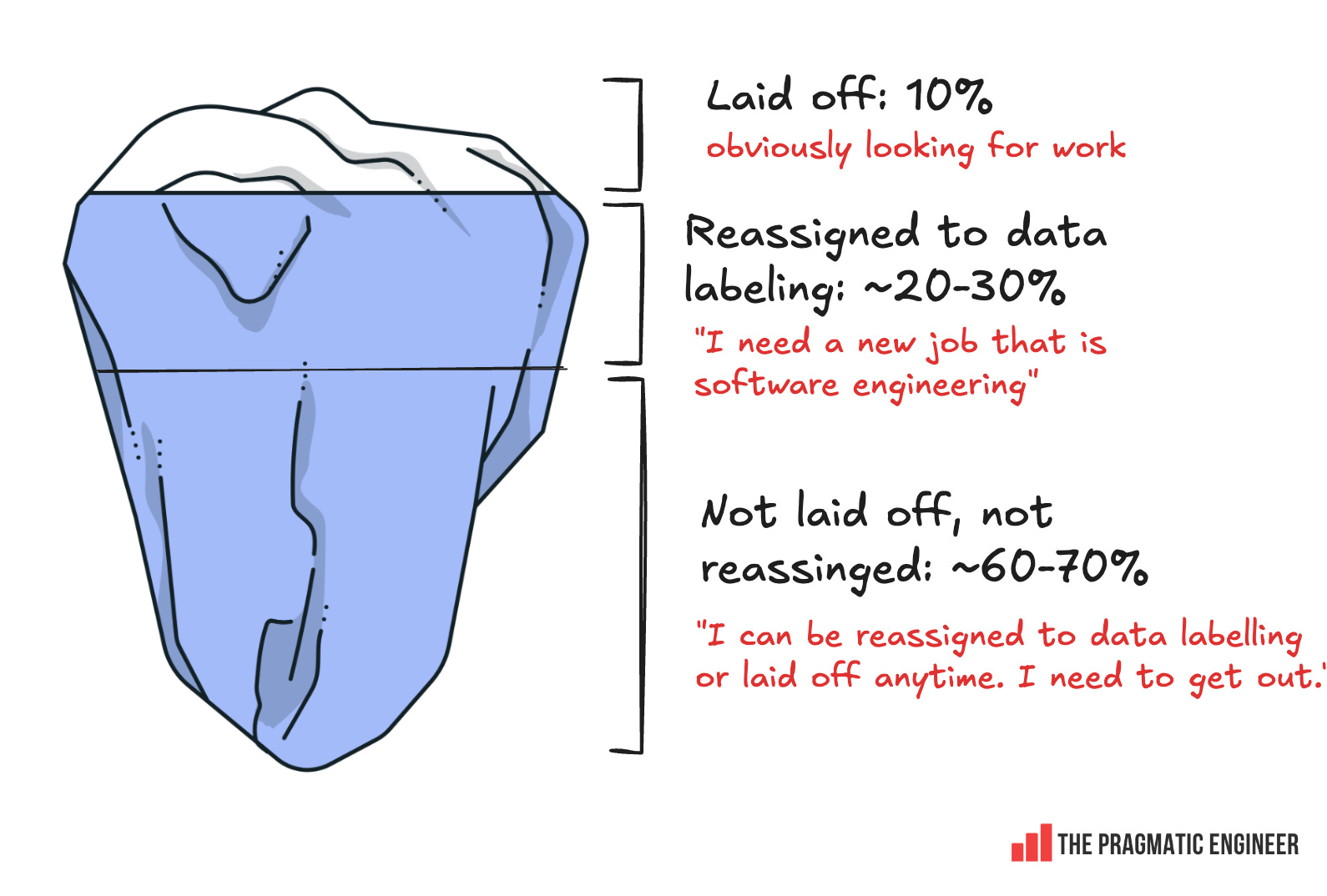
Every longer-tenured engineer is seeking a new job, or at least considering it. Those who have been around at Meta longer term have seen enough. Let me describe this visually:
Why pretty much every engineer at Meta is looking for a way out, visualised
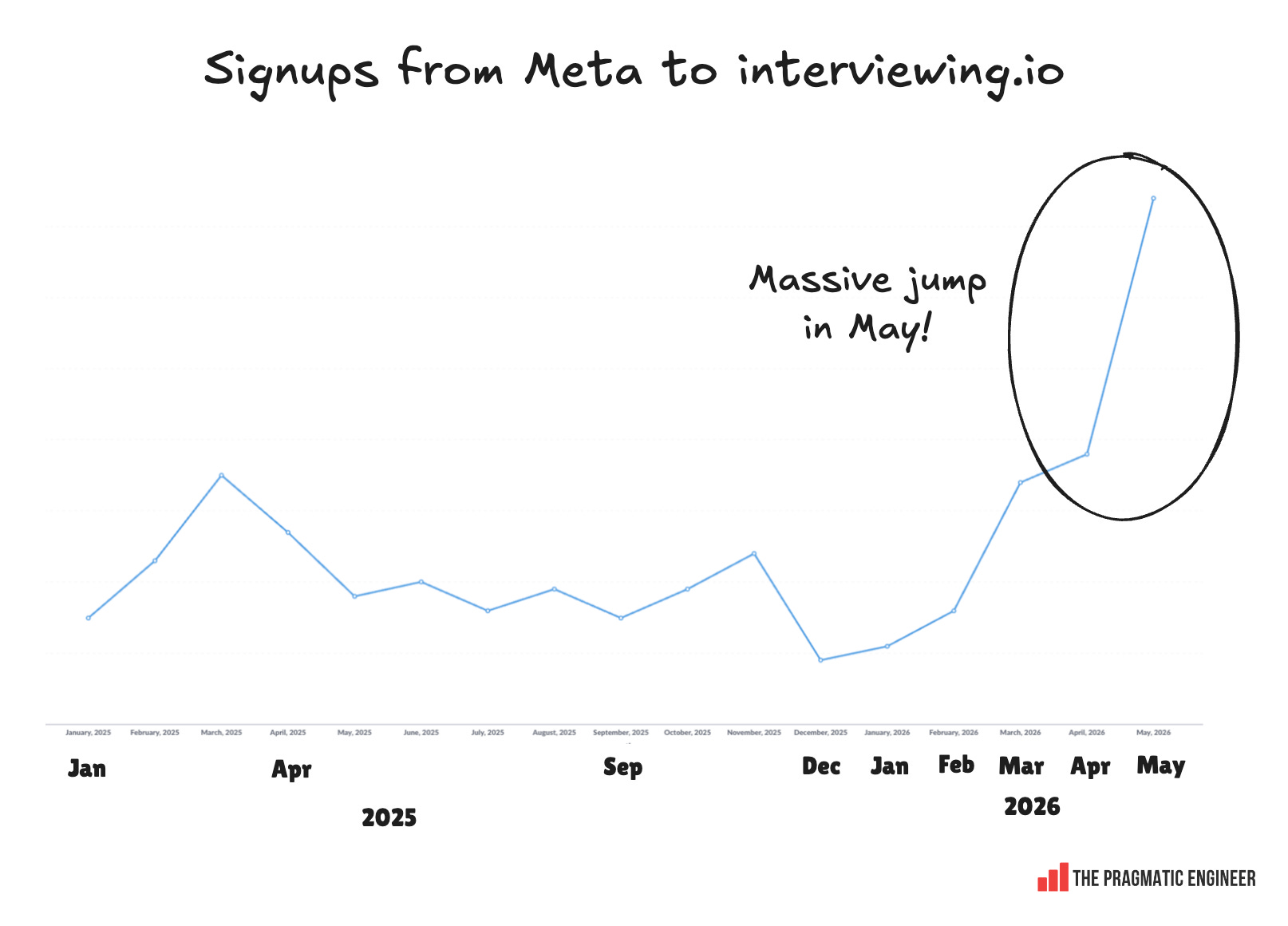
Fresh data seems to confirm that starting in May, a lot more engineers at Meta are looking for an “out.” Here’s how signups to leading Big Tech interview preparation service interviewing.io from Meta have changed over the last year and a half: we can see a massive jump in May vs the year before, as shared by founder and CEO Aliner Lerner with us:
Signups to interviewing.io’s interview prep service from Meta. Source: interviewing.io.
To its credit, Meta has given out generous retention equity packages to several engineers considered key on the remaining teams. These packages make it harder to get matching compensation elsewhere. Still, I talked to one engineer who got an equity top-up, and said that this approach helped him decide to leave as soon as possible because he feels bitter about the lack of autonomy and having no control over things.
4. Most embarrassing-ever outage
Meta’s core infra and security teams have suddenly found themselves severely understaffed. Most folks are pushing AI-generated code merged with AI-only reviews, without paying much attention to quality. After all, they’re dealing with the possibility of unemployment, while firefighting to operate a team without its best engineers whose headcount has been cut in half, all with the knowledge that AI usage could affect their own job security.
Two weeks ago, on 30 May, the most embarrassing outage in Meta’s history happened. Here’s software engineer Siddharth Sundharam’s summary (emphasis mine):
“Yesterday, a slew of Instagram accounts, including some high profile ones like the Obama White House account, seemingly got hacked.
Look, I’m no spring chicken. I’ve spent almost a decade and a half identifying vulnerabilities and exploits at unicorn scale, but this is hands down the most unserious, “almost too stupid to be true” of them all.
The Takeover Flow:
Step 01: Faking the Location & Initiating Support. All the attacker needs to kick this off is your account username. Then, they hop on a VPN or proxy close to your city so Instagram’s security algorithms don’t suspect a thing. (You can quite easily get this from your public profile or “About” section or a hundred other ways.) Once it looks like the request is coming from the correct region, they tell the Meta support AI that the account is hacked and ask it to send the verification codes to an arbitrary email address they control.
Step 02: That’s It. Really, that’s it.
The first proper zero auth password reset I’ve seen in production. There appears to be no additional check as to whether the email being given is actually something the user has used before. Once the AI sends the security code to the attacker’s email, the attacker passes it right back to complete the verification. The platform hands over a fresh password reset link, granting full ownership to the attacker.”
This is a security breach in which Meta left its extra-secure, reinforced front door unlocked, so that anyone could come in, and there was no alarm to notify anybody when it happened! It seemed Meta only noticed when users started reporting it on social media!
From talking with folks inside Meta, I’ve learned that AI was at the heart of this outage. AI-generated, AI-reviewed code, and security teams being gutted were together the cause of this beyond-embarrassing incident. I poked around, and here’s what I gathered:
Instagram’s Trust and Safety Team lost around 50% of its staff to data labeling and layoffs. Some of the most senior folks were drafted onto AI training tasks.
AI-generated changes that saw no human input, just another AI code review, were very common during the last two months, across the codebase. The change that caused this outage looked like one of these
Normally, the Trust and Safety team would be on top of monitoring and alerting of security breaches, but it is currently in full disarray due to rapid, internal disorganization.
Meta’s Chief Security Officer resigned the very next day. The outage was resolved on Monday, 1 June, and an investigation started as part of the SEV process. On Tuesday, Meta’s Chief Information and Security Officer (CISO), Guy Rosen, announced his departure.
Coincidence? I suspect not: the CISO might have stepped down if they warned against the Security org being gutted but were then ignored, and so no longer trusts leadership. I also imagine the CISO didn’t have the idea to move a good half of Instagram’s security team over to data labeling.
As a note, the previously worst outage was all Meta services going down for seven hours in 2021, due to a DNS / BGP configuration issue. It was a bad outage, but Meta handled the follow up well, in my opinion. After that 2021 outage, Meta shared a postmortem and apology. It has not done so for the latest Instagram account takeover outage.
5. Internal mess
Wired shares more details on just how bad the situation is inside Meta, right now:
“Someone interrupted a livestreamed, employee-only presentation at Meta earlier this week with an expletive-filled outburst about “being the company’s bitch,” according to a recording heard by WIRED. The individual then asked the people leading the call to write to a specific Meta AI executive and “tell him that he’s a piece of shit.”
The incident, which took place on a call open to thousands of employees, reflects growing frustration inside the company’s Applied AI team, which was formed in March to support the work of AI researchers at Meta Superintelligence Labs. Three current employees tell WIRED there is widespread dissatisfaction with how Meta assembled the unit of about 6,500 engineers and product managers and the drudgework they allege they have been assigned to improve AI models.
“It’s literally the gulag,” one of the employees claims. “You have zero purpose in life all of a sudden, you barely interact with anyone, you just have these tasks every week.”
There’s more: Meta’s Chief Product Officer, Chris Cox, reportedly admitted to staff that Meta’s upper leadership (the folks above him, meaning the C-level at Meta) created the mess. Also from Wired:
During a meeting this week open to all employees at Instagram, Meta chief product officer Chris Cox addressed the “difficult” and “brutal” environment created by the “insanity of this company” in the past few months, according to a recording heard by WIRED. Cox applauded Instagram employees for launching features and serving around 2 billion users amid what he compared to “running a marathon in the middle of a hailstorm and then, like, your teammate gets replaced and then we’re recording you.”
“It’s like what the fuck,” he said, drawing laughs, before repeating himself. “It is like what the fuck.”
6. Self-inflicted wounds
So, is there an ultimate source of the “insanity of this company”, as CPO Chris Cox put it? Engineers whom I talked to point the finger at two individuals: Mark Zuckerberg and Alexandr Wang. Zuckerberg has full control over the business, and has made the decisions to reallocate a good part of engineering folks to data labeling, to roll out tracking software, and to lay off 10% of staff when Meta achieved record revenue and profits. As the CEO, the buck clearly stops with him.
But it’s hard to unsee that – outside of layoffs – everything that Meta is doing is taken from the Scale AI playbook, and that surely comes from Wang:
Mandatory keystroke and mouse tracking to generate training data
Forced data labeling with 4,500+ engineers is to generate high-quality RLHF, surely for Meta’s under-construction coding LLM
Taking away the best engineers from the heart of the business is surely signed off by Mark Zuckerberg, believing that it is more important for Meta to train a coding AI than it is to operate its core business like Instagram, Facebook or Messenger reliably. Oh, did I mention that on Saturday (12 June) Facebook and Instagram had another SEV0, that is, a full-on outage?
Before all this happened, Meta was on track to overtake Google as the world’s #1 ads business by the end of the year. But for some reason, Mark Zuckerberg decided that building a coding LLM is more important.
Meta’s leadership is now trying to undo all the damage they have done. Wired reports that Meta CTO, Andrew Bosworth, admitted to staff that the AI reorg was atrocious and committed to better communication in the future.
To me, it looks obvious that Zuckerberg doesn’t care how engineers feel about the massive changes, and that Bosworth likely ignored the chaos, all while engineers know for a fact that the next AI model matters more than they do to the business. Bosworth also said that employees will have access to AI coaching tools. Very considerate, given the situation!
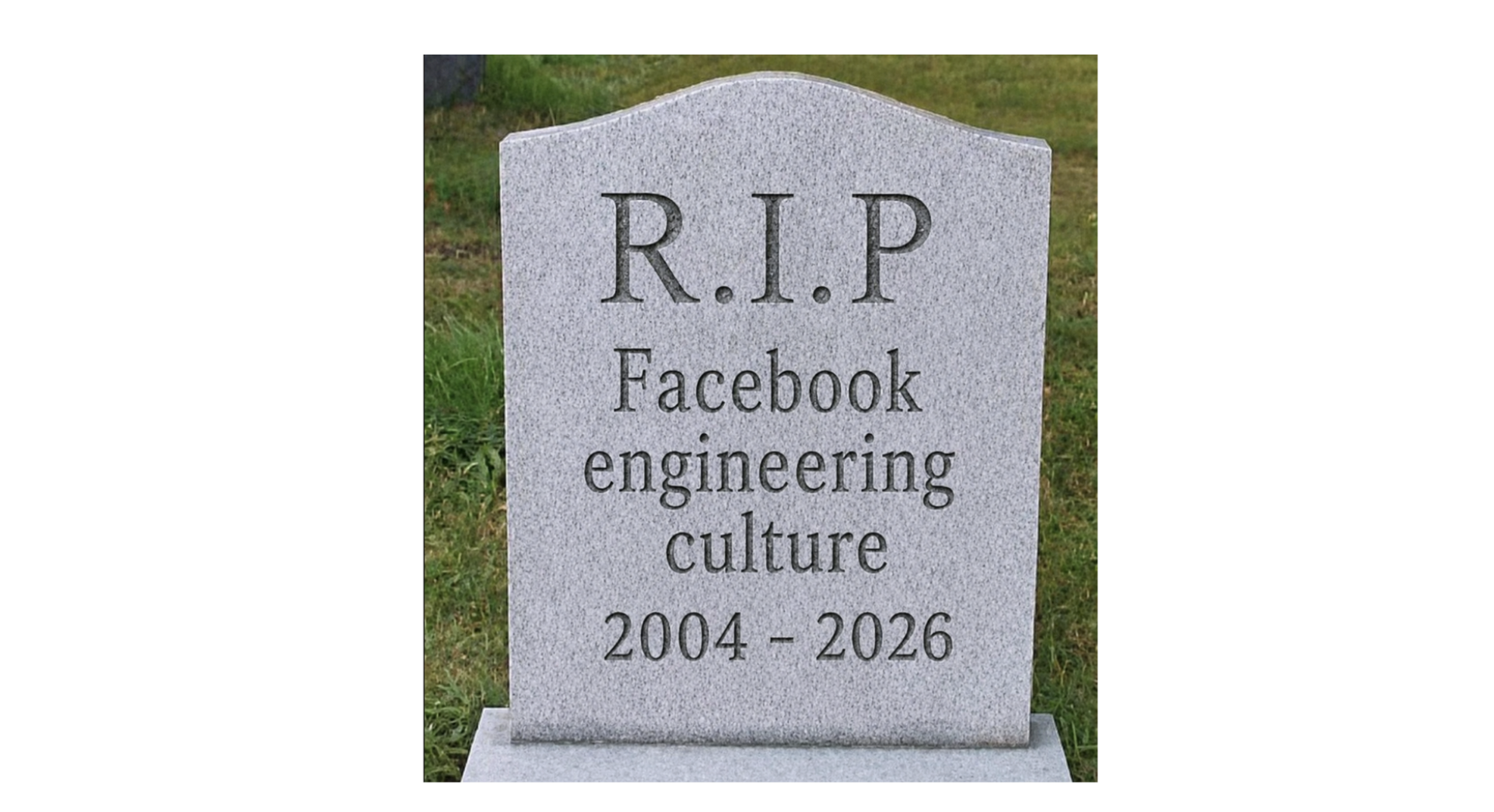
Based on all I’ve learned, Meta’s engineering culture is dead because leadership has made it clear that engineering at the company is a cost center.
Nice while it lasted
Needless to say, I hope my assessment is way off, but I’ve seen nothing yet from Mark Zuckerberg and Alexandr Wang – the two executives creating this current mess – to suggest it is. There may be a short time period where, if major changes like data labeling assignments and staff tracking are undone, then things at Meta could return to normal. The longer the current conditions persist, the more tenured engineers will surely leave.
7. Is “AI psychosis” just a Meta issue?
It’s tragic to see a technical founder at Meta so focused on AI that he neglects the engineers who built the heart of his company. But is Meta a one-off exception?
Mitchell Hashimoto (creator of Ghostty, founder of HashiCorp) says he is seeing similar behavior by other founders (emphasis mine:)
“I strongly believe there are entire companies right now under heavy “AI psychosis” and it’s impossible to have rational conversations about it with them. I can’t name any specific people because they include personal friends I deeply respect, but I worry about how this plays out.
I lived through the great MTBF vs MTTR (mean-time-between-failure vs. mean-time-to-recovery) reckoning of infrastructure during the transition to cloud and cloud automation. All those arguments are rearing their ugly heads again but now it’s... the whole software development industry (maybe the whole world, really).
It’s frightening, because ‘psychosis folks’ operate under an almost absolute “MTTR is all you need” mentality: “it’s fine to ship bugs because the agents will fix them so quickly and at a scale humans can’t do!” We learned in infrastructure that MTTR is great but you can’t yeet resilient systems entirely.
The main issue is I don’t even know how to bring this up to people I know personally, because bringing this topic up leads to immediate dismissals like “no no, it has full test coverage”, or “bug reports are going down” or something, which just don’t paint the whole picture.
We already learned this lesson once in infrastructure: you can automate yourself into a very resilient catastrophe machine. Systems can appear healthy by local metrics while globally becoming incomprehensible. Bug reports can go down while latent risk explodes. Test coverage can rise while semantic understanding falls. Changes happen so fast that nobody notices the underlying architecture decaying.
I worry.”
The takeover outage at Instagram was exactly like this: the engineering team dropped the quality bar for AI-generated and AI-reviewed code, probably expecting that they could recover quickly from failures. And they did indeed recover… after the damage was done, high-profile Instagram accounts were hacked, and the system was compromised, all very publicly.
Mitchell highlights the specific concern of founders over-estimating the capabilities of AI, and consequently casting aside sensible safeguards when shipping code to production.
Takeaways
Most of us probably have something to learn from the disastrous events at Meta caused by hyper-focus on AI to the exclusion of people who are the lifeblood of that company.In some good news, I’m hearing that in the UK, some of the 10% layoffs have suddenly been cancelled: at the end of the mandatory consultation period, several infra and security teams are learning that no engineers on their team will be let go, as originally expected.
Meta has a booming business, and is already a beneficiary of AI via increased ads revenue. Meanwhile, my Facebook feed is filled with fake, AI-generated videos, with hundreds of comments from bots and people who seemingly don’t realize it’s AI. It all seems like just more content for Meta to show ads next to.
And yet, despite business booming, Meta’s leadership has gone on a crusade to inflict the most damage possible on its engineering org. Apparently, they’re now learning that most of it was pointless.
If you’re in a leadership position and feeling the temptation to make drastic org changes for AI-related reasons, take a deep breath and see where it left Meta. Meanwhile, If you’re an engineer at a company whose leadership is over-indexing on AI, consider forwarding this article as additional context.
If you’re hiring standout engineers who are extremely hands-on with AI, then it’s never been easier to get talent from Meta, than right now. Every engineer I know at the company is an extremely early adopter of AI, and knows how to build products and AI infra. These folks have soured on the company and its leadership. Meta’s loss of talent will be the gain of other startups and the rest of Big Tech; it’s one benefit of AI that’s probably a bit unexpected – not least of all by Meta!
It seems like the old mantra of “move fast and break things” has now extended to Meta’s engineering org itself, with the company’s rush to over-invest in AI, so it will avoid missing the latest mega-trend in the tech industry.
The Pulse is a series covering events, insights, and trends within Big Tech and startups. Notice an interesting event or trend? Hit reply and share it with me.
Today, we cover:
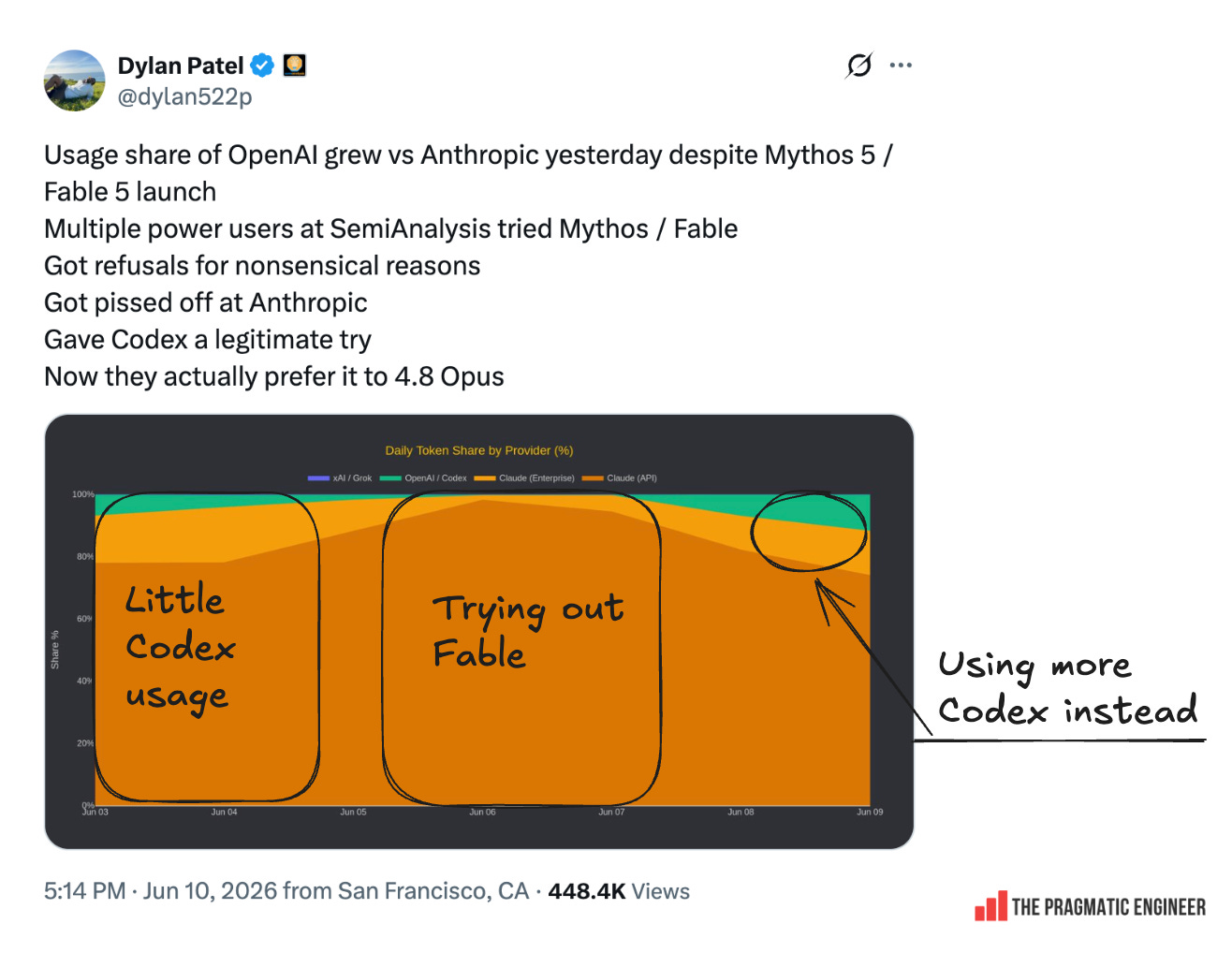
Anthropic alienates customers with Fable’s data retention and nerf policies. Anthropic’s latest mode, Fable, stores customer prompts and data for 30+ days and performs worse if Anthropic thinks devs’ usage could potentially pose a commercial threat. The launch is an urgent reminder to have an off-ramp from Claude if you want to be able to vote with your feet.
New trend: smart model routing. Are there any ‘intelligent’ router solutions out there which select the right model for the right task? I looked into it, and there are a few options. More suggestions welcome!
Reliability fail: No automated zone failover for Coinbase’s global trading service. Back in 2016, Uber had a cross-region failover for its core business. Ten years later, Coinbase does not, so it’s little wonder the platform suffered an embarrassing 10-hour outage. The big mess is a head scratcher.
Industry pulse. Anthropic and OpenAI file for IPOs, open source project quits GitHub after maintainer banned without appeal, Opendoor “reshores” jobs from India to the US with AI-native engineers, and more.
Are LLMs eroding software engineering skills? A software engineer admits they feel increasingly useless due to how capable LLMs are, in an article that has resonated with lots of folks. My sense is that we give too much credit to LLMs, while underestimating our own capabilities and understanding.
1. Anthropic’s new model release is a reminder to have an off-ramp plan from Claude
What’s going on in today’s job market? We try to answer that big question in this second part of our deepdive into the tech employment market, following Part 1 on the tech jobs market in 2026, published two weeks ago.
First of all, a big thank you to partner teams for sharing exclusive details for this deepdive:
Interviewing.io: anonymous mock interviews with engineers from top companies. Thanks to founder and CEO, Aline Lerner.
Workforce.ai, built by Live Data Technologies, which monitors 1M+ job changes and 300M+ employment validations monthly, across companies, roles, levels, functions, industries, and locations. Special thanks to Alex Hamilton for his input.
SignalFire: a VC firm with a standout data analysis team. Ordinarily, their data is used to give their portfolio companies a major commercial advantage, but they made an exception to share some for this article. Special thanks to Asher Bantock.
TrueUp: a platform that scans every open job in Big Tech, top startups, and scaleups, typically paying in the top two tiers of the trimodal software engineering compensation model. Thanks, Amit Taylor.
Today, we cover:
Top AI labs are now more attractive than Big Tech. Anthropic is most in demand among job candidates for interview preparation services. Along with OpenAI, it’s almost certainly the place with the most competition for jobs in tech.
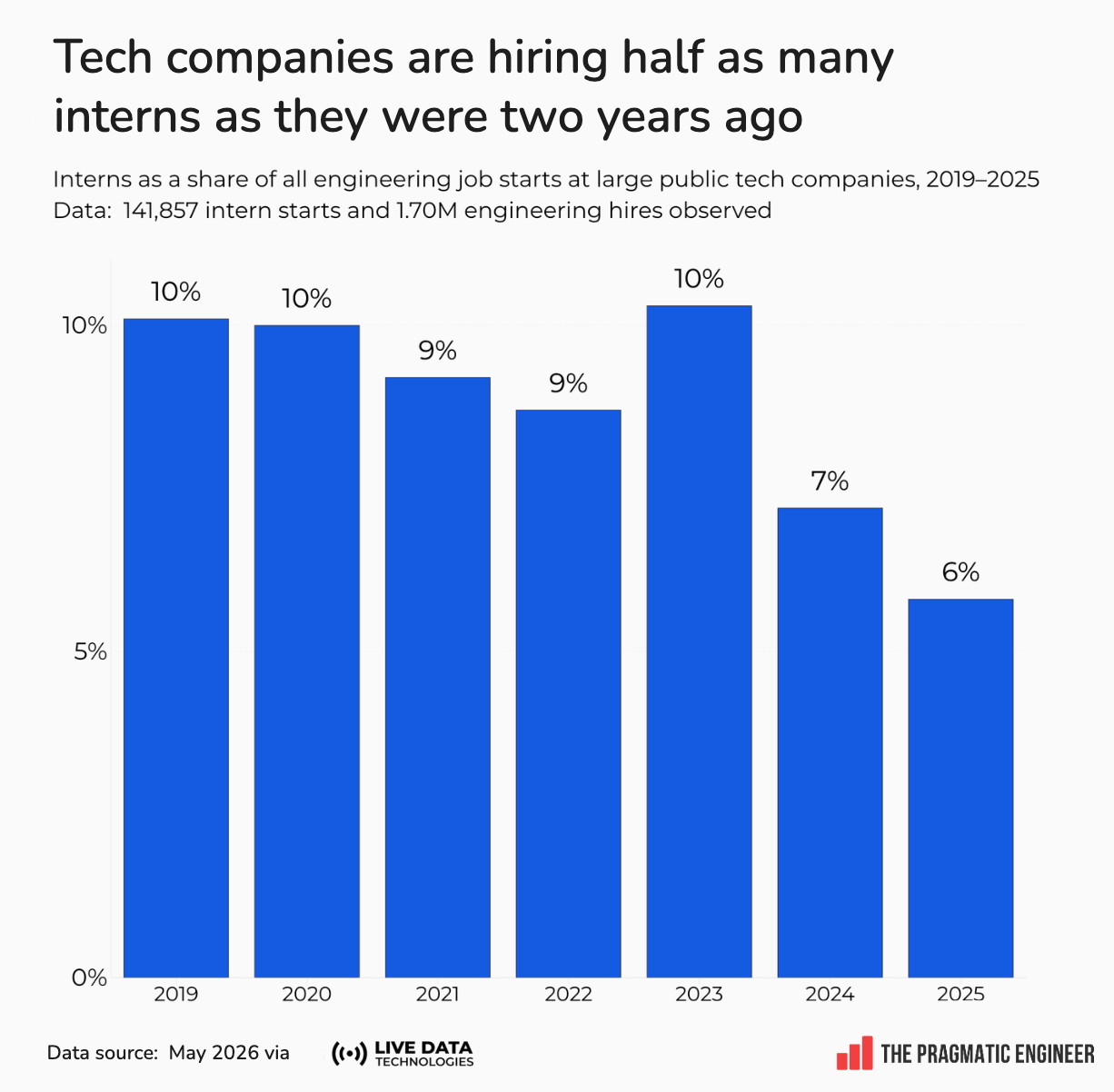
Harder for new grads & interns to get hired. Data shows that intern intakes have fallen, even as software engineering recruitment recovers. Large tech companies take on half as many interns as before, and candidates’ work and educational backgrounds matter more than ever.
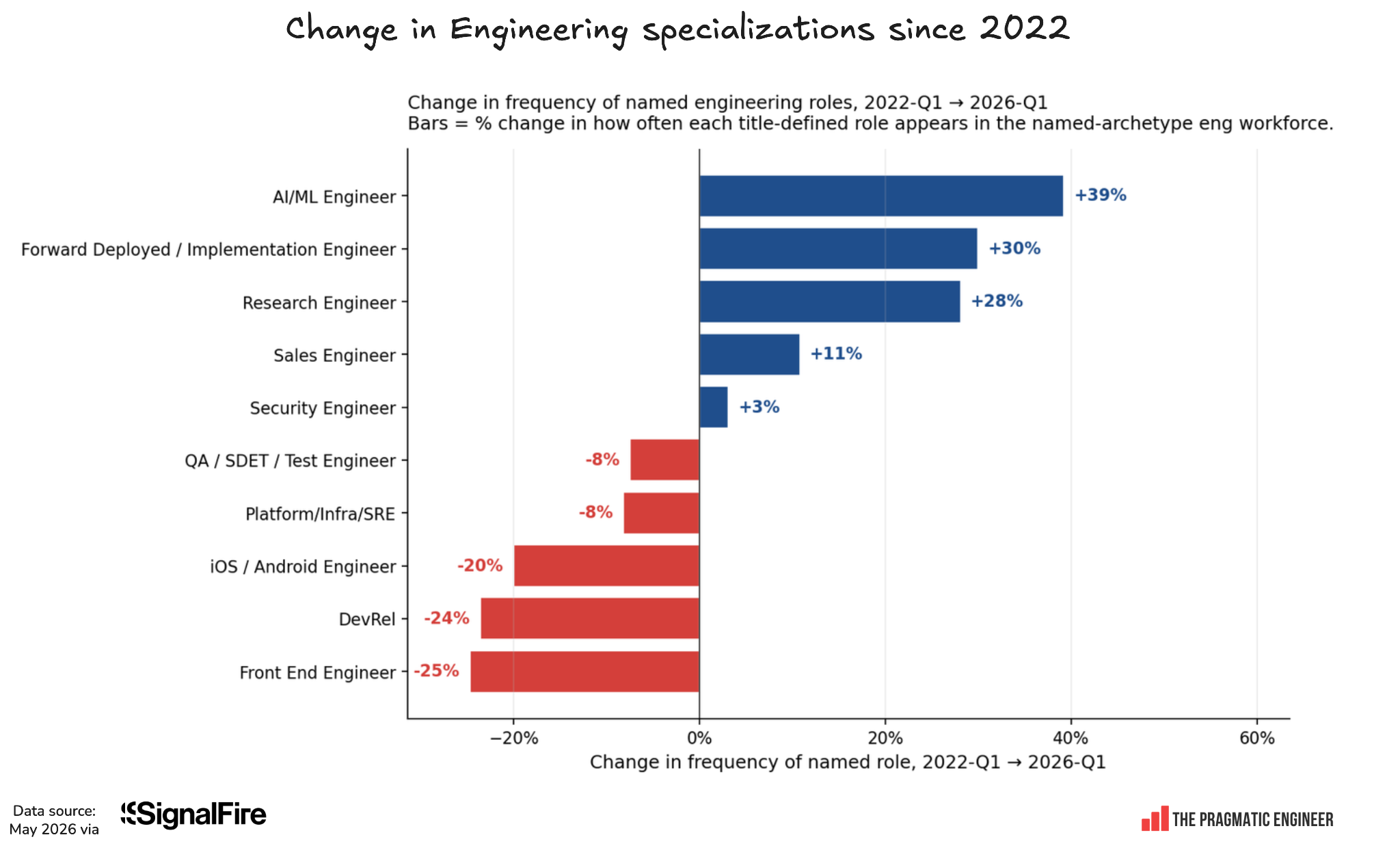
Mobile and frontend demand drops, AI & FDE surges. Frontend engineer titles are disappearing fastest across the industry, followed by native iOS and Android ones.
AI engineering comp > software engineering comp. AI engineers are more in demand than software engineers, and get higher compensation offers, especially with equity. At the 80th percentile in the US, $300K+ base salaries are the norm now for senior engineers.
Management’s “great flattening” continues. There are fewer engineering managers for each engineer across the industry, and fewer VP of engineering and director of engineering posts at Big Tech.
Big Tech seniority & tenure keep rising. Since the end of zero interest rates in 2023, it’s as if there’s fewer ways to tempt Big Tech workers to switch jobs, so they remain in situ.
Interview preparation signups: what do they indicate? Companies doing mass layoffs tend to see the biggest surge in devs signing up to practice interviews. A list of the top 20 companies from where engineers are preparing to interview elsewhere.
Where engineers go after Big Tech. From Amazon, they go pretty much everywhere. From Google, Apple & Meta, it’s mostly to AI labs. Microsoft is where the most ex-workers become their own bosses by working for themselves next.
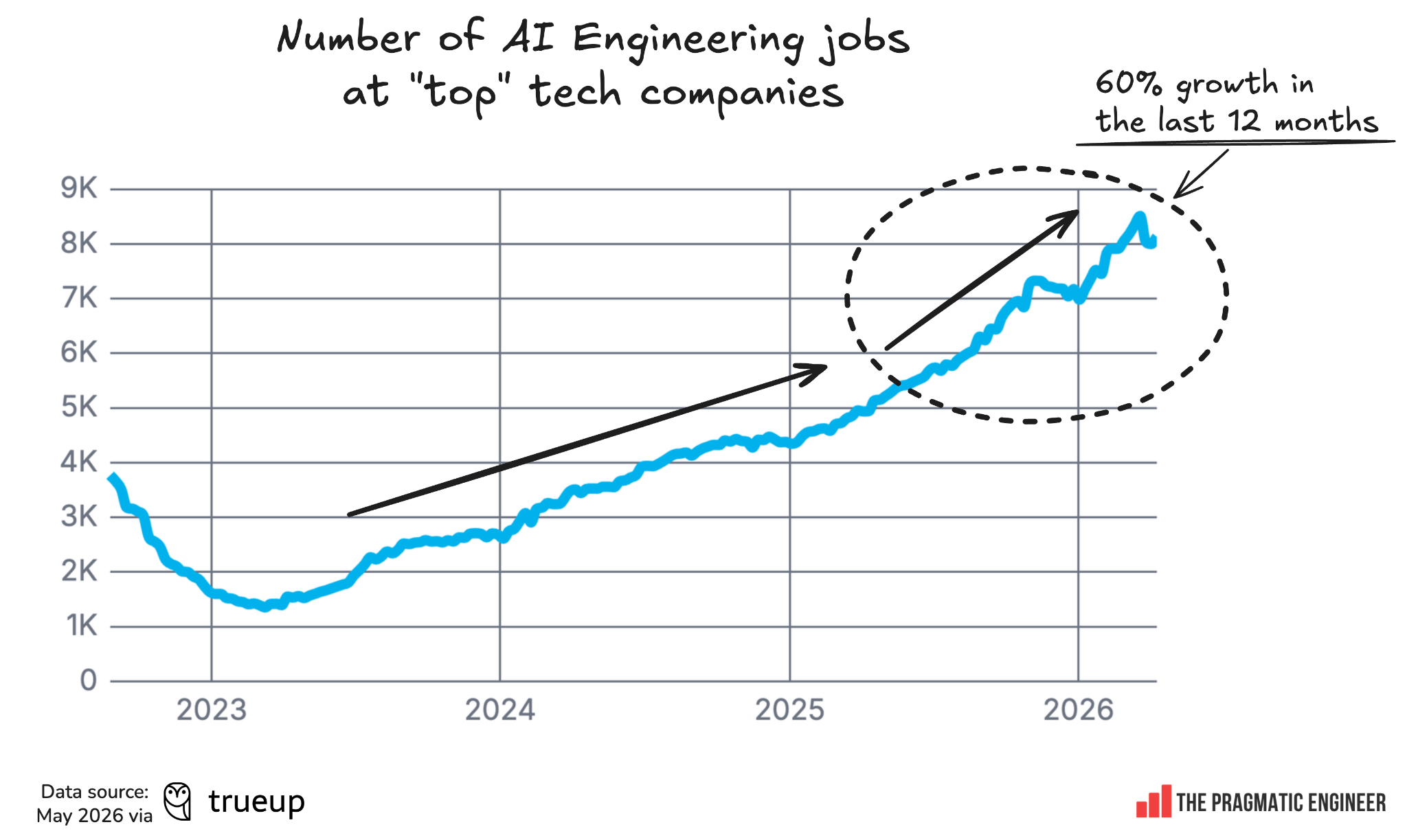
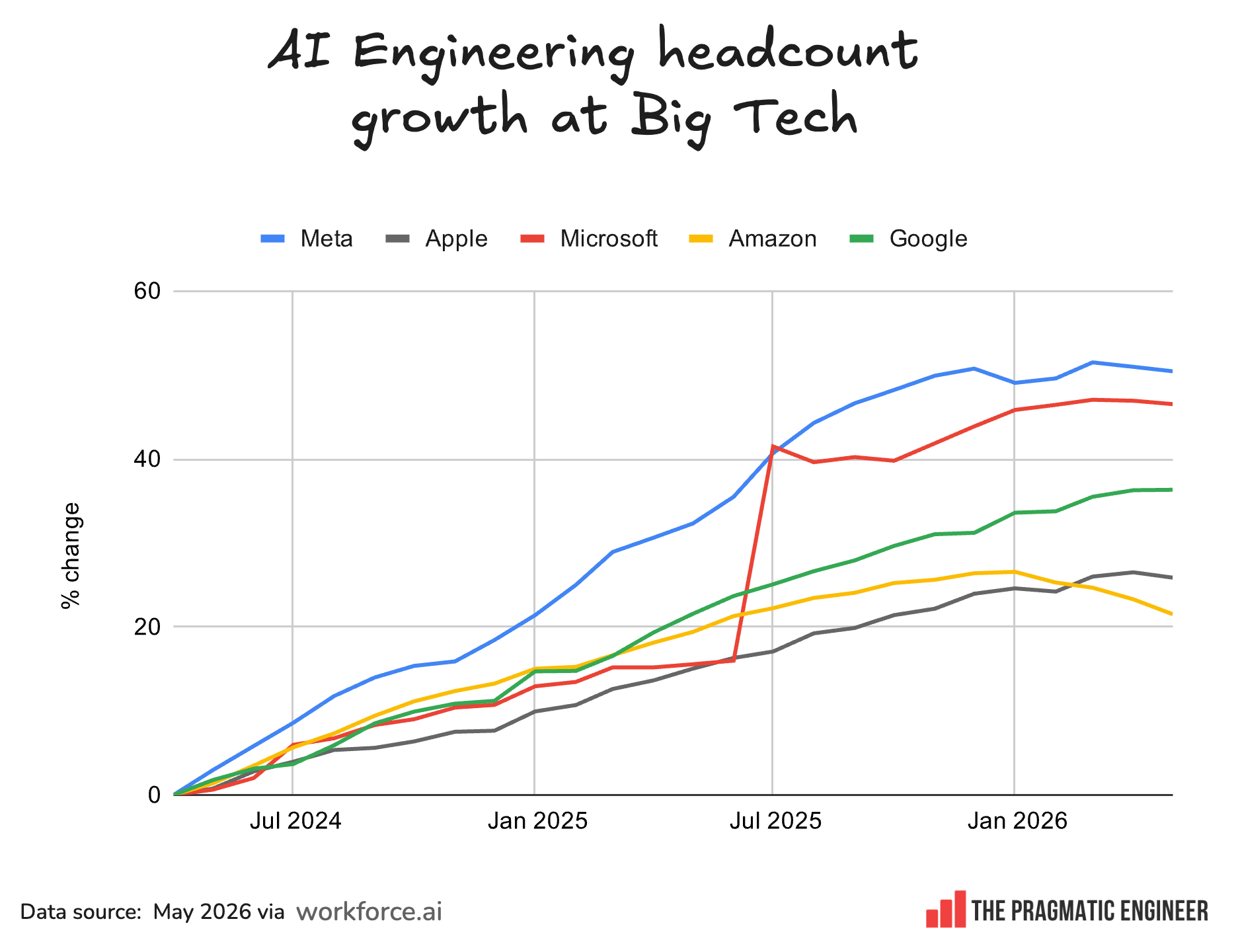
AI engineering job openings have increased 60% in the past year at top companies, while software engineering openings grew by 7% in the same places. We also found that Big Tech is significantly growing AI engineering headcount:
AI engineering headcount growth at Big Tech. We look into Microsoft’s spike in Part 1. Source: Workforce.ai
Anthropic: most in demand
New data suggests that the two biggest AI labs are attracting the most candidates to apply for their AI engineering roles, which is pretty predictable.
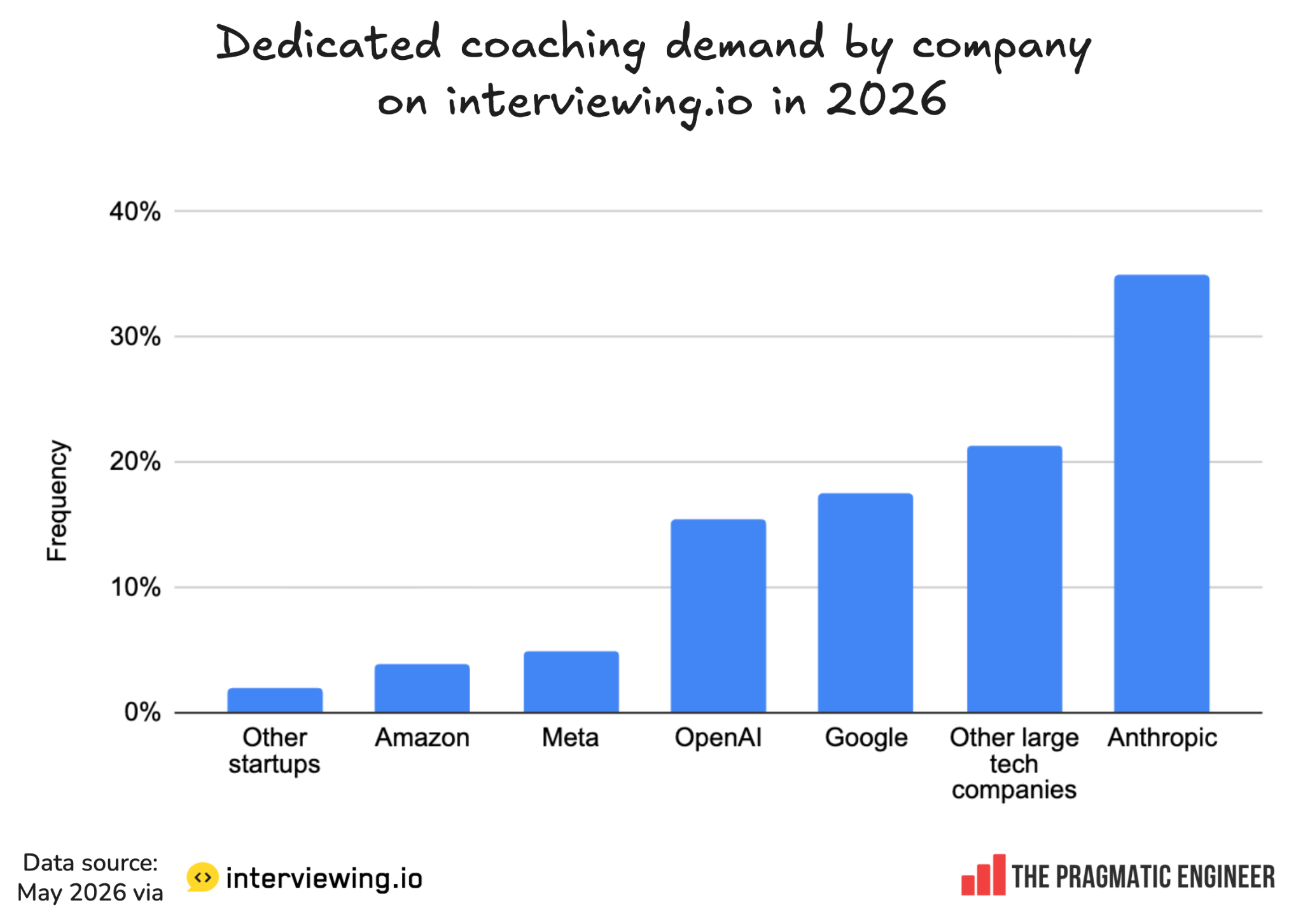
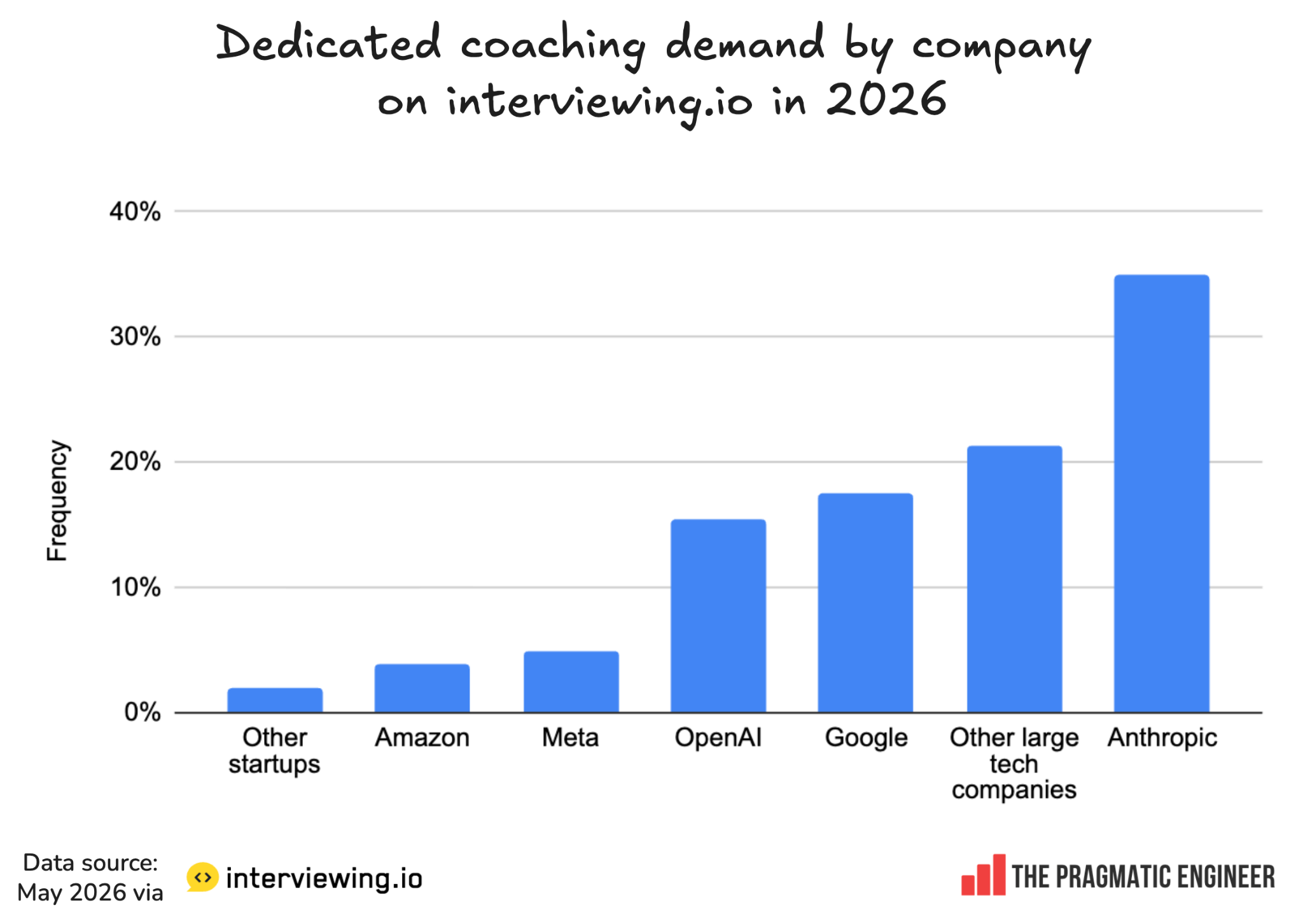
Interviewing.io is a job interview preparation service which offers coaching for clients who are getting ready for interviews at specific companies. Based on the number of mentions by clients, Anthropic is the one most candidates are preparing for with paid coaching, and it’s not even close:
Most popular employers in coaching prep. Source: interviewing.io
It’s also notable that OpenAI (16% of candidates) gets around the same share as Google (17%) and other large tech companies (17%). Combined, Anthropic and OpenAI account for 51% of all interviewing.io coaching requests. For context, interviewing.io only added coaching for frontier labs this year!
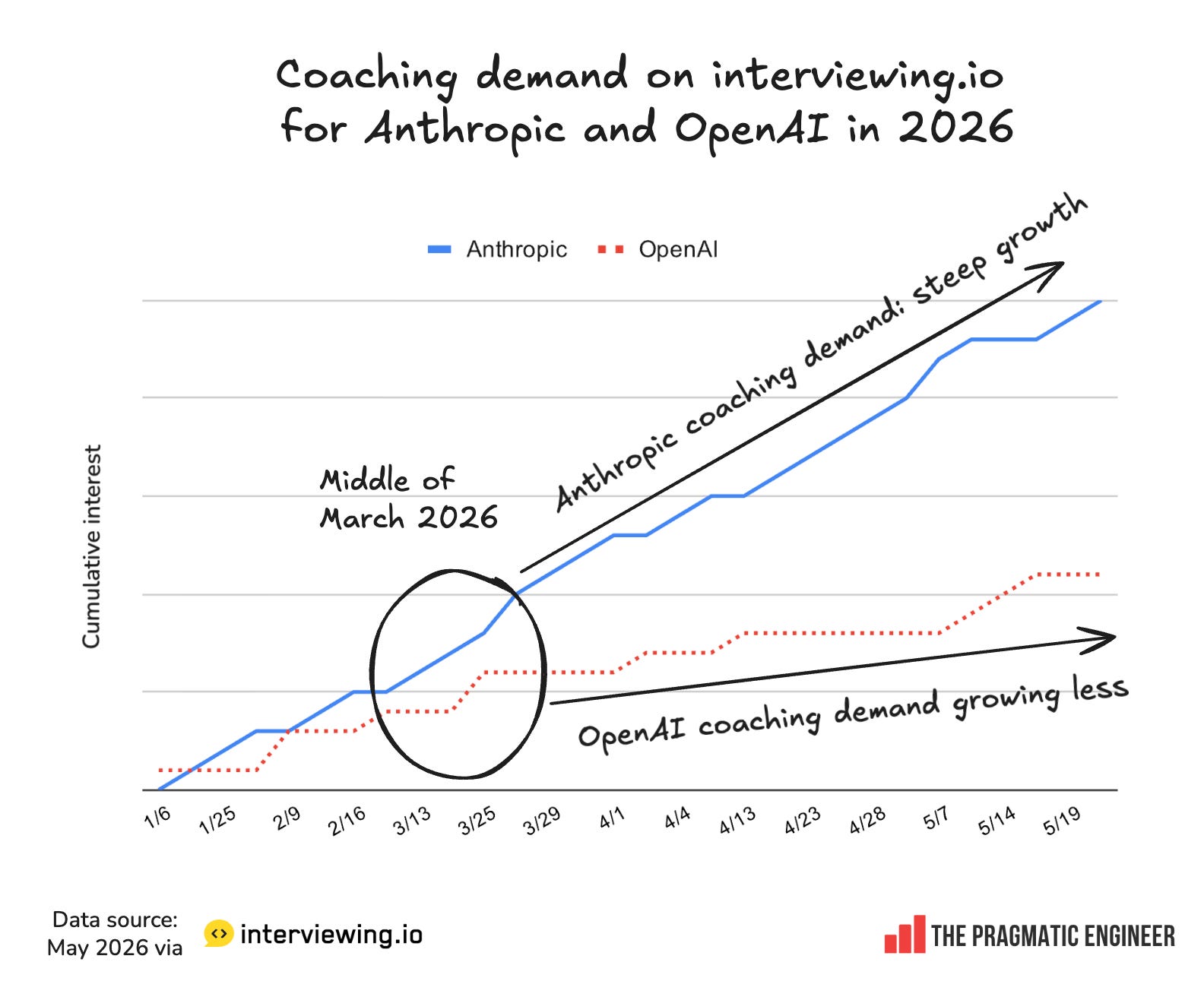
Weekly coaching demand for Anthropic vs OpenAI. Source: interviewing.io
There are a few potential causes of the surge of interest in Anthropic:
OpenAI replaces Anthropic as AI supplier for the US’s novel ‘Department of War’. In early March, the US Government controversially declared Anthropic a “supply chain risk”, and appointed OpenAI as its AI supplier, after Anthropic raised concerns about the future use of AI in mass surveillance and fully autonomous weapons. This raised suspicions that OpenAI agreed to cross ‘red lines’.
Anthropic’s market dominance continues. Claude Code is the most popular developer tool, as found by our AI tooling survey in February. It seems little has changed.
Anthropic’s value exceeds OpenAI’s. In March, Anthropic raised a $65B funding round at a $965B valuation, making it more valuable than OpenAI for the first time.
Anthropic files to go public first. Last week, Anthropic filed to go public, beating OpenAI which has done so a week later.
Anthropic also recruited the most in-demand AI researcher, Andrej Karpathy, in May. My sense is that between the two labs, Anthropic has more momentum for the time being, and has perhaps acquired a ‘halo effect’ with its seemingly principled stance. It’s not surprising that it’s attracting more candidates.
Where are AI labs hiring from?
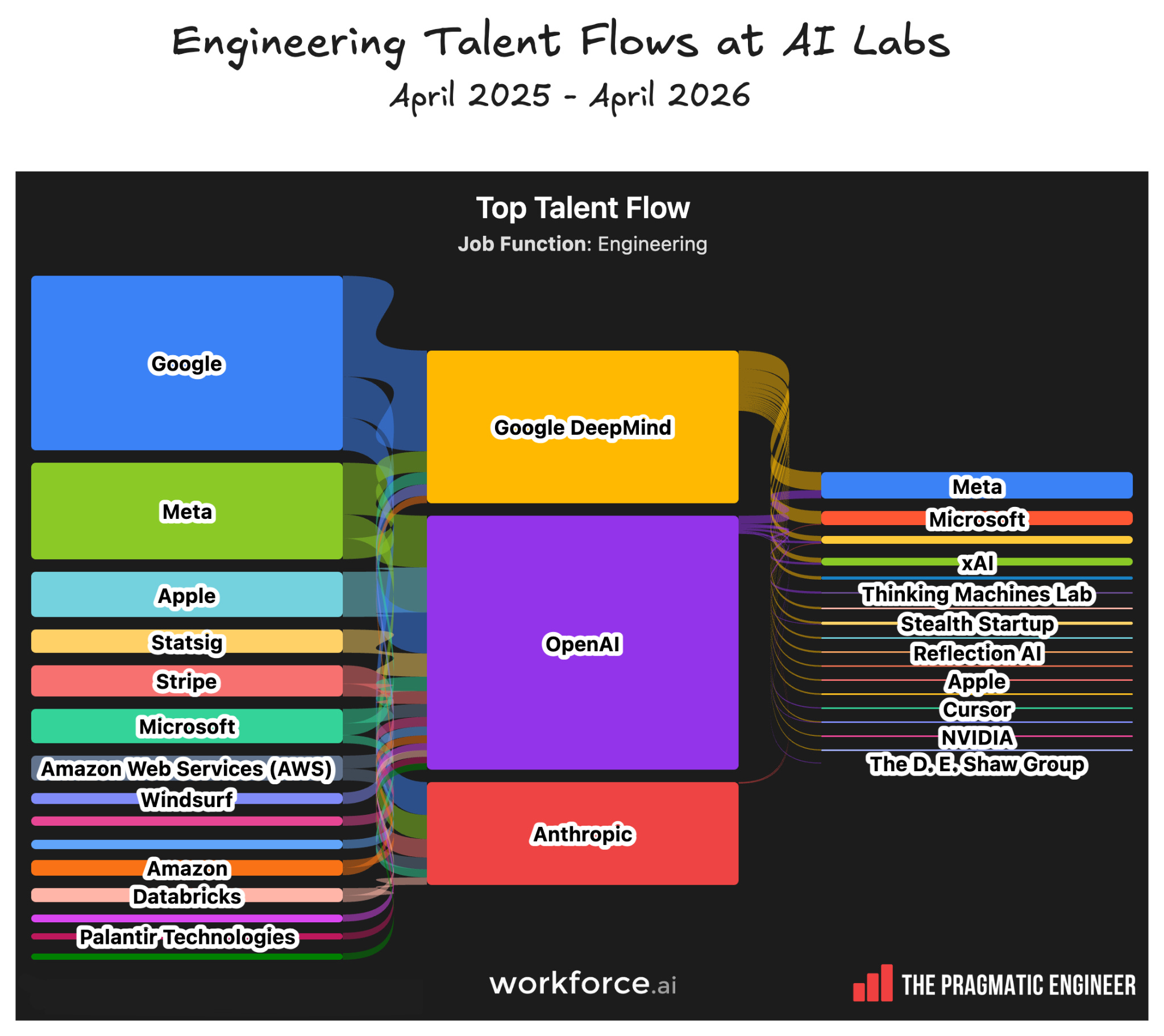
We looked into the sources of recruits to the three most in-demand AI labs: Anthropic, OpenAI, and Google DeepMind. Here’s what we found:
Where top AI labs recruit from, and where folks go next. Source: workforce.ai
Where Anthropic hires from, in order of popularity:
Google (often Google DeepMind)
Meta
Stripe
Microsoft
Amazon (AWS)
Databricks
OpenAI:
Google
Meta
Apple
Stripe
Statsig (after OpenAI acquired Statsig)
Microsoft
Amazon (mostly AWS)
Databricks
Airbnb
NVIDIA
Google DeepMind:
Internal transfer
Meta
Microsoft
Amazon
Windsurf
Anthropic has the highest retention rate of all AI labs. Data from SignalFire found the 2-year retention rate (percentage of employees who stay 2 years) is:
OpenAI: 67%. This is consistent with the rest of Big Tech
Google DeepMind: 78%. Well above the rest of Big Tech
Anthropic: 80%. Standout, industry-wide!
Consistent with SignalFire’s 2025 finding, OpenAI 2-year retention was 67% (FAANG-level) versus Anthropic (80%), and DeepMind (78%).
2. Harder for graduates & interns to get hired
It’s well known that it’s getting harder to be hired as an early-career engineer, and new data underlines this.
Intern intakes down since 2022
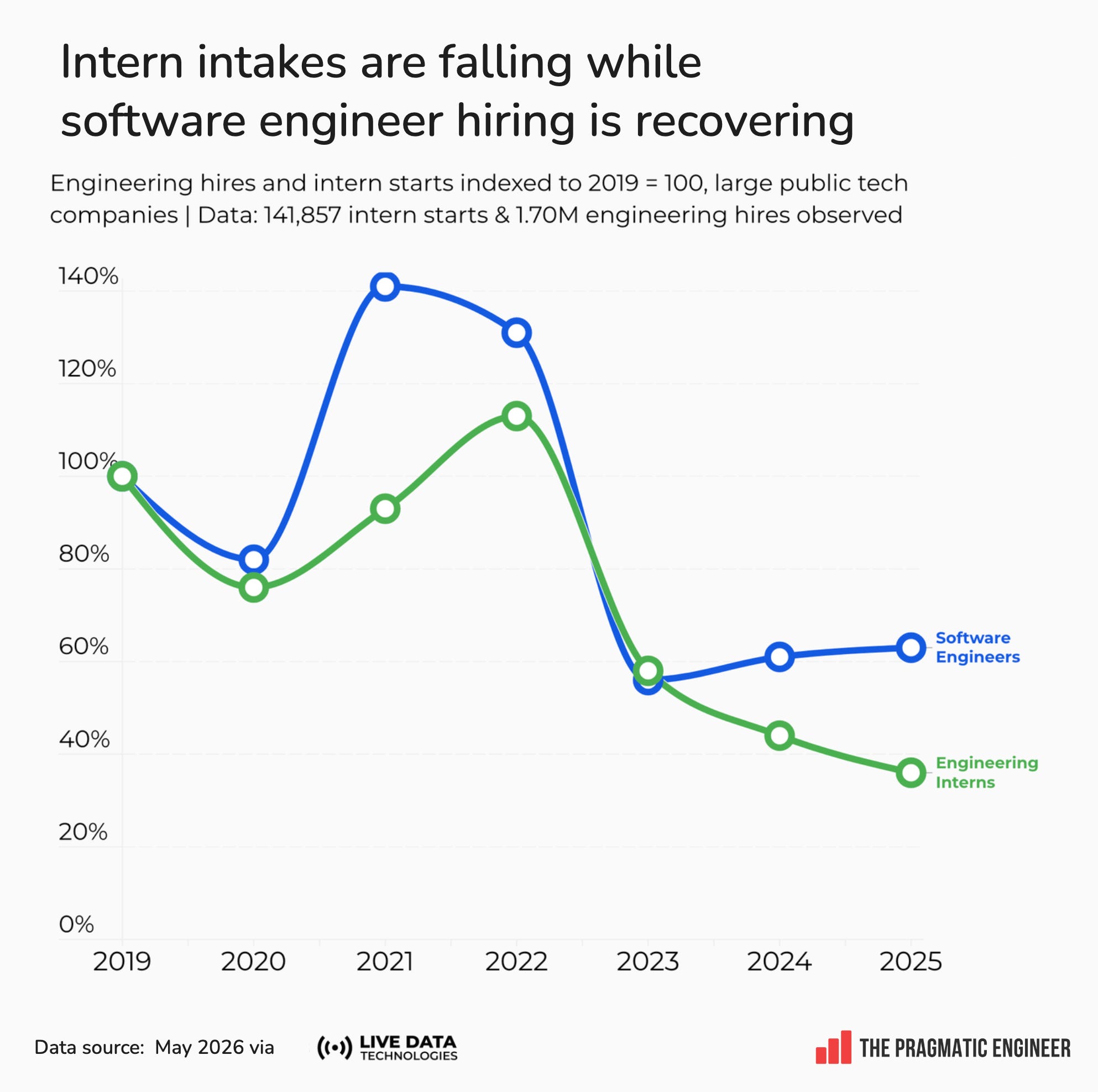
Live Data Technologies looked at software engineer vs engineering intern hiring trends at 30-80 US-based tech companies, pinned to 2019 hiring numbers (100% being that year’s total number of hires). The spread is wide because Live Data Technologies selects the top few dozen companies that meet their criteria for a “large public tech company” in their database.
The findings:
Intern hiring is falling, but not software engineering recruitment. Source: Live Data Technologies
Zooming into intern hiring, here’s a visualization of it as a percentage of all appointments:
Tech companies are hiring fewer interns. Source: Live Data Technologies
Alex Hamilton, analyst at Live Data Technologies, says:
“We’ve seen overall software engineering hiring start to come back since the 2023 tough market. However, intern intake just kept falling alongside it, which isn’t what you’d normally expect.
Historically, intern programmes have tended to bounce back pretty quickly once companies start hiring again. That hasn’t happened this time, and 2024 and 2025 are the first years in the series where the two lines are moving in opposite directions.
Where you do see companies holding intern intake steady or growing it, it’s almost always a reflection of where they are as a business, be that earlier-stage or faster-growing companies, rather than any kind of broader market recovery”.
Graduate jobs trending down
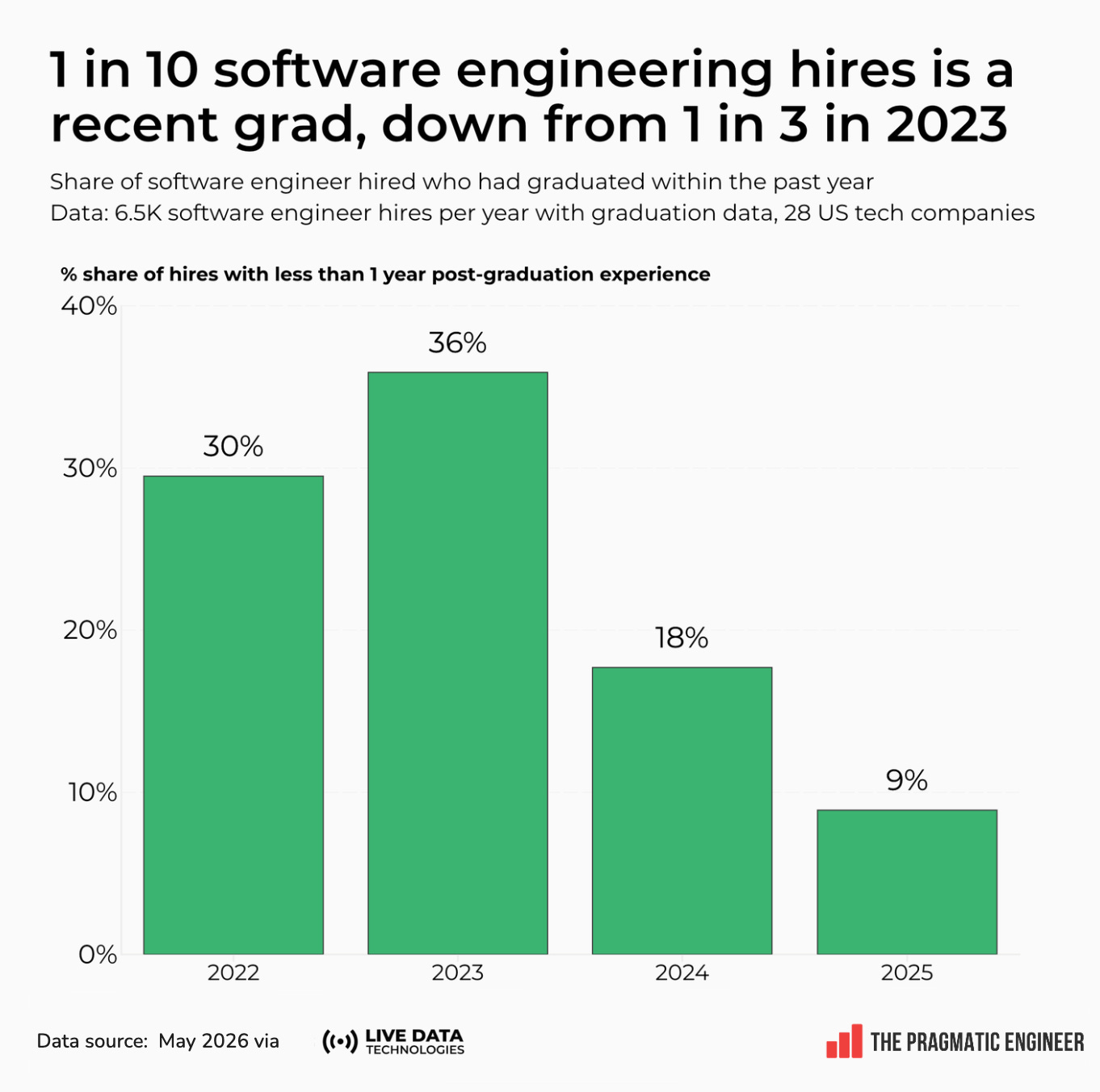
Anecdotally, we hear new grads continue to have a hard time finding a position. Our new recruitment data on major US tech companies confirms it:
Share of new grad recruitment at 28 large US tech companies. Source: Live Data Technologies
“New grads” in this data are software engineers who graduated less than a year before getting a job as a software engineer. In 2025, just one in 10 engineering hires at larger companies were recent grads, down from nearly three in 10 in 2023.
Pedigree matters more for new grads
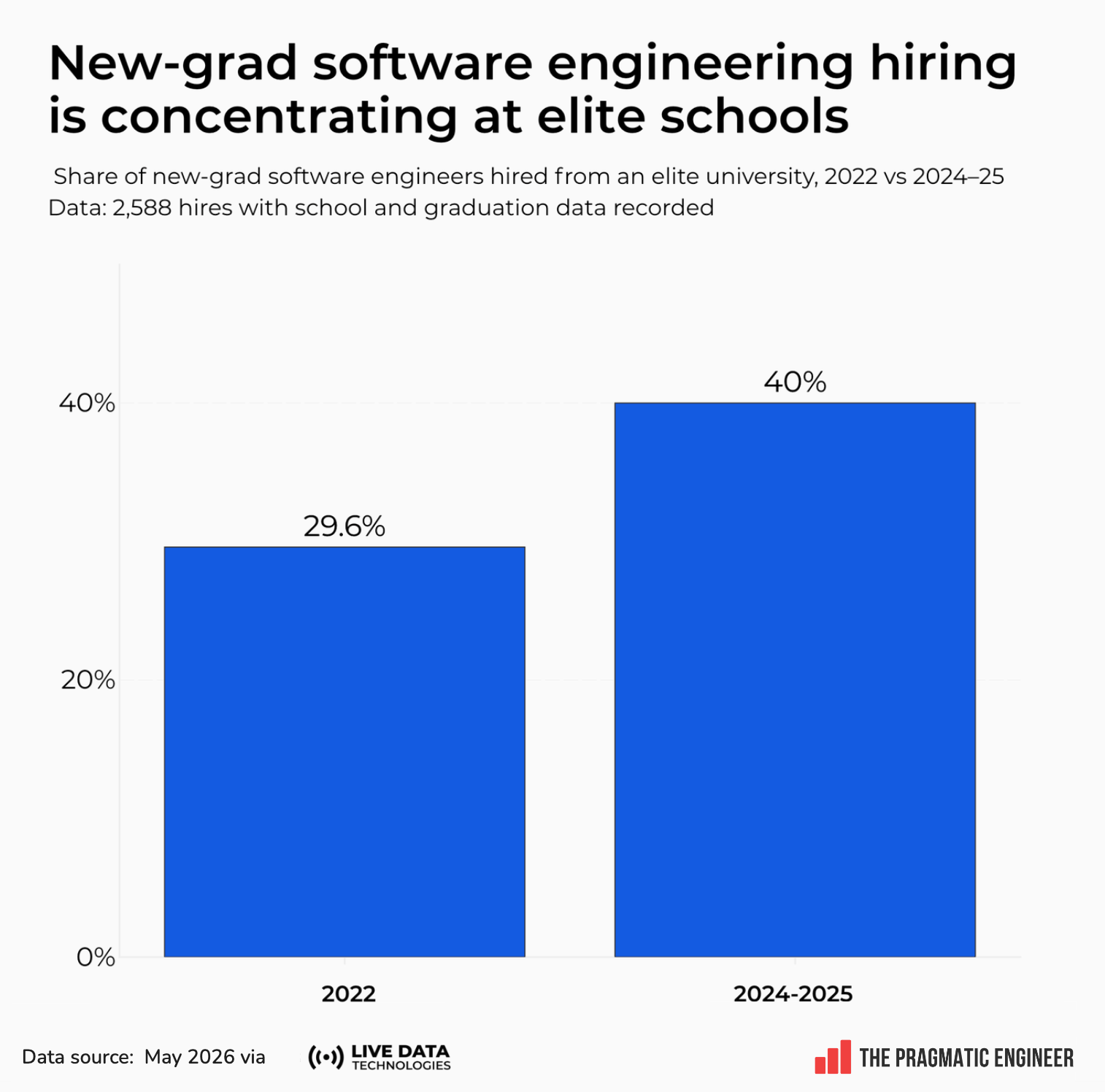
We looked closely at the places from where new graduate software engineers are joining US-based tech companies, and found the share of successful candidates from “elite” universities is growing:
Source: Live Data Technologies
By “elite” universities, we mean one of the top 20 US colleges for computer science, such as MIT, Stanford, Carnegie Mellon, UC Berkeley, Harvard, Caltech, Georgia Tech, and Cornell.
Obviously, the influence of these places’ reputations is not a new thing, it’s what makes them “elite” universities, after all. But with new grad hiring down across tech, even graduates from these universities can expect fewer opportunities than before.
Even so, the pedigree that comes from graduating from a well-known university, or doing an internship at a well-known company, becomes ever more significant as the job market tightens.
3. Mobile and frontend demand drops, AI & FDE surges
Here’s interesting data showing the shifting prevalence of job titles on sites like LinkedIn over time:
How engineering titles changed in the last four years. Source: SignalFire
Some takeaways:
AI engineering’s on fire. This is not surprising and is evident throughout our study.
Forward Deployed Engineers (FDE) are growing rapidly. We covered the sudden demand for FDEs in 2025, and this year we’re seeing the FDE role heat up again.
Modest increase in sales engineers: Sales engineers help close large, B2B-type, deals, and are typical at companies selling to enterprises. The rise in prevalence of this position suggests more companies are targeting enterprise-scale clients. Also, my sense is that FDEs can operate like sales engineers.
There are fewer native mobile engineers. In 2022, I observed a drop in demand for native iOS and Android engineers. Cross-platform frameworks being more capable today may contribute to fewer places investing in native applications, and a fall in demand for this discipline overall. Is the “golden age” of native mobile development over, with its standalone native iOS, native Android, and web teams for a single product?
Frontend-only engineers are disappearing. This is one of the most interesting trends in the data. I’ve observed full-stack engineers become the norm at many places, who can do both frontend and backend development. Especially with AI, there is no reason a proficient frontend engineer should not work on backend as well, so, I expect “pure” frontend engineers will be employed only in larger companies, where demand exists for things like building a design system. We cover more on this topic in the deepdive, Design systems for software engineers.
4. AI engineering comp > software engineering comp
One poorly-kept secret in tech is that although software engineering compensation is very good at Big Tech and top startups, it’s superior for AI engineering jobs at the same places – and even better at leading AI labs:

 Connexion